The debate between four-stroke and two-stroke dirt bikes buzzes through garages, pits, and social media threads. Both engine types offer unique experiences on the track and trail, which is the essence of this debate. This particular guide will explain how each engine works, performance comparison, handling differences, maintenance needs, cost differences, environmental limitations, and compatibility with riding styles. It will show how brands like Apollino provide alternatives across both categories and how the options are a perfect fit for riders at any level. You will have clarity to choose the match that suits you best.
Let’s first understand how each engine works, and then explore how they feel to ride in terms of performance and handling? A very basic understanding of the mechanics explains the different sensations when riding.
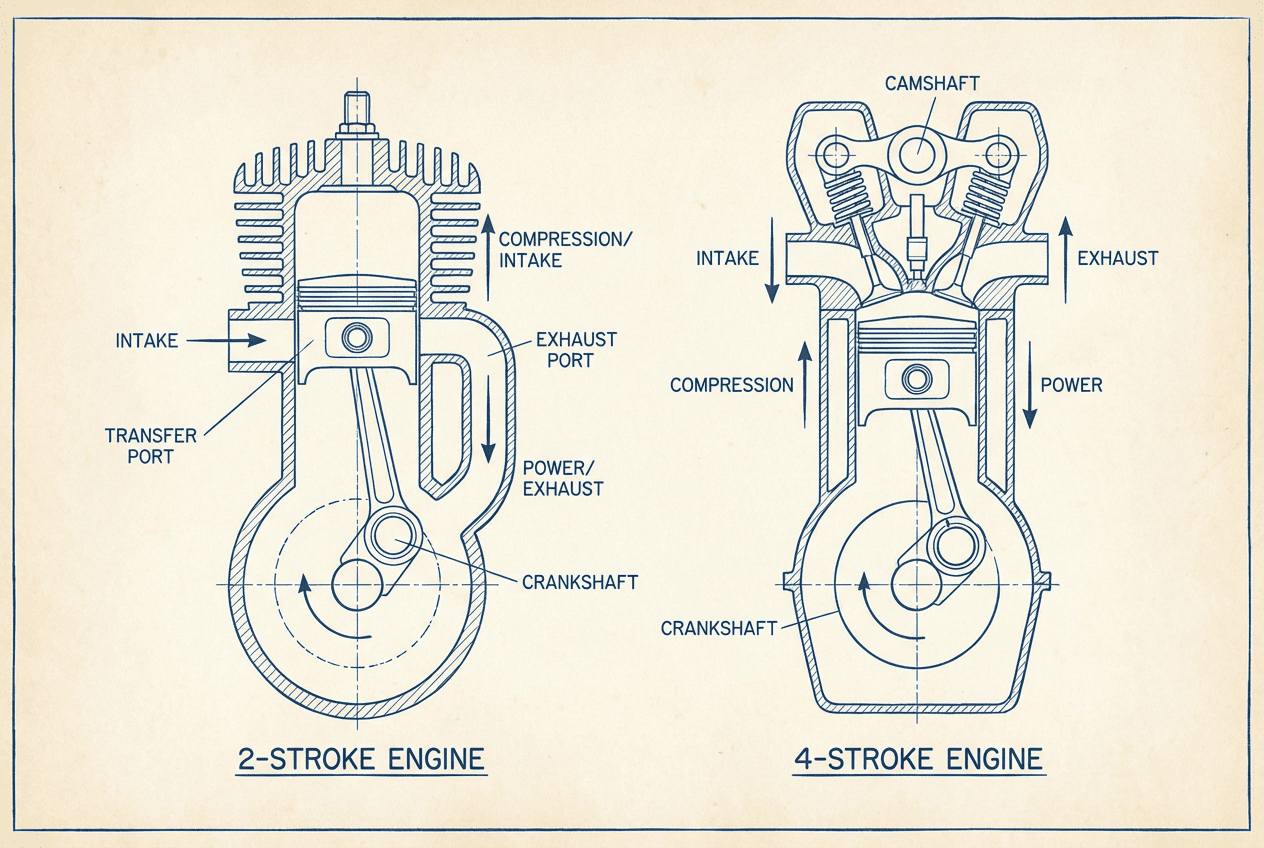
Power is created by a 2-stroke dirt bike engine, not with every turn of the crankshaft but with respect to the number of times a power stroke is delivered. In a 2-stroke engine, the crankshaft makes one complete revolution for each power stroke. Indeed, it makes the device mechanically simpler and lighter so that it has a very high power-to-weight ratio. The two-stroke combustion cycle is completed with a single upward and downward movement of the piston, producing a power stroke with every revolution of the crankshaft. This results in rapid bursts of energy and a high power-to-weight ratio compared to four-stroke engines. A notable characteristic of two-stroke operation is the sharp, high-frequency exhaust note, generated by the rapid firing cycle and the design of the expansion chamber, which makes the sound instantly recognizable. It is very much part of the thrill for many riders that tells them they are riding a Two-stroke engine dirt bike.
The dirt bike’s 4-stroke engine completes two revolutions of the crankshaft to finish the combustion. The two revolutions make it such that a single power stroke is produced for every two turns of the crankshaft. Therefore, there is a smoother and more even kind of power delivery. More weight is combined in that construction, where torque can bring more at lower RPM ranges, thus providing more predictability for those tough terrains; yet, the sound is somewhat “heavy” and less “intrusive,” something most riders agree is “not fatigue-inducing” during long rides. However, weight and complexity come with their own tradeoff; more parts are in every system, which again weighs into long-term maintenance considerations.
The first feel of performance occurs at the start when you are lined up at the start gate or when heading into the woods. Both types definitely have clear points of strength and weaknesses with respect to conditions.
The throttle has an effect on the feel of the bike. A 2-stroke engine comes on instantly, with power hitting as soon as you twist the grip. That power delivery makes them great for situations where quick bursts are needed, either clearing jumps or doing things like overtaking in tight corners. On the less experienced, that immediacy can throw off at times. In contrast, the power output builds gradually on the 4-strokes, which does good things for traction on all sorts of surfaces. With this steady delivery, it gives the sort of advantage you want when you are attempting to steer through slippery or uneven terrain, where it’s control rather than raw acceleration you’d prefer to have.
A two-stroke bike is usually lighter than a four-stroke of the same class, which makes it easier to flick into corners, weave around obstacles, and change direction without feeling weighed down. For this reason, many riders prefer two-strokes on tight, technical tracks where agility is key.
In contrast, four-stroke engines add more weight, but with that mass comes stability at higher speeds and in open sections of the track or trail. Their smoother, more predictable power delivery also reduces arm pump and mental fatigue over long rides, allowing the rider to focus on precision rather than fighting to stay in control.
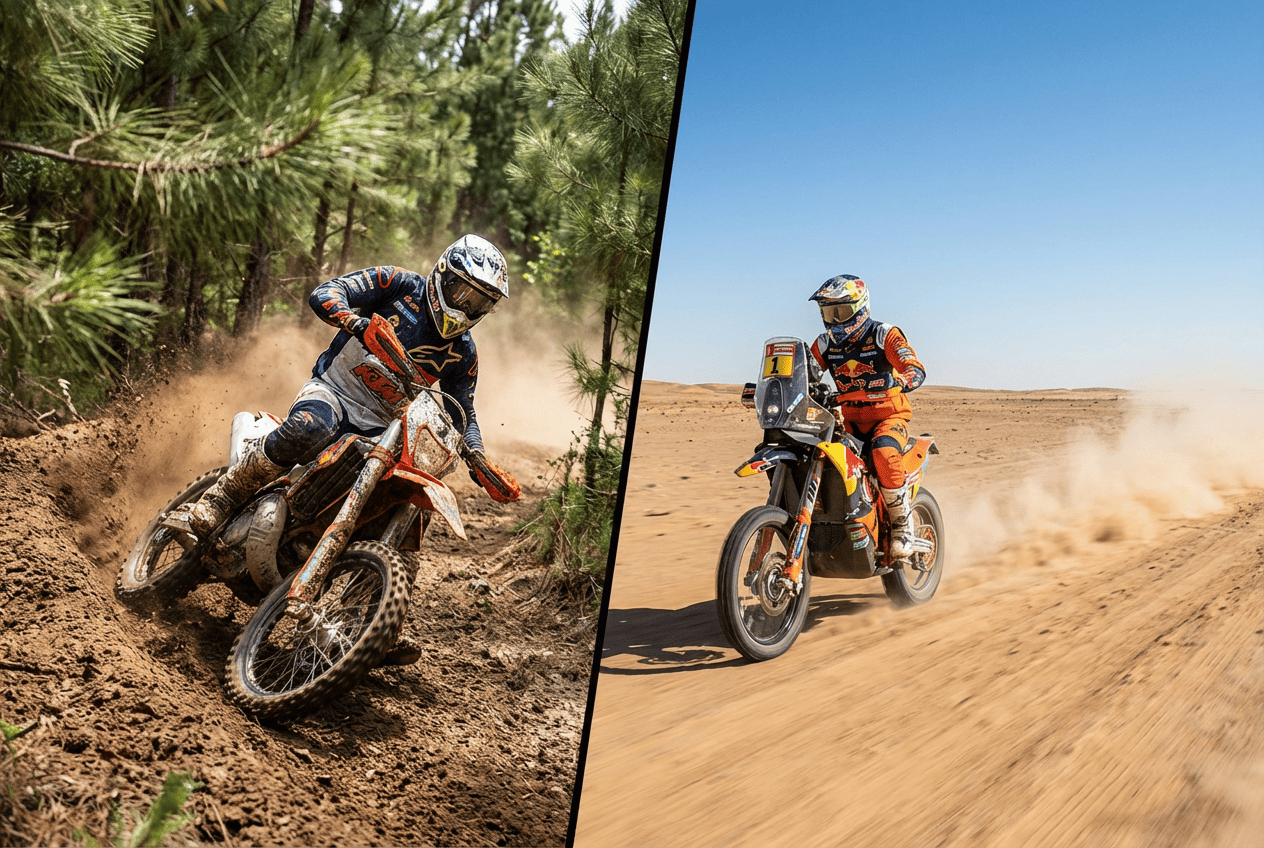
Maybe sound and vibration are not really important, but they actually matter when it comes to comfort in riding. More vibration and a more prominent exhaust note make 2-strokes exciting for short runs, but are tiring for long rides. For the thrill-seekers, noise is part and parcel of the whole fun and excitement ride. 4-strokes do quieter and smoother work, putting needless strain on the body. Therefore, they are preferred to riders who remain in the saddles for hours to complete the ride, only to find themselves without exhaustion and with no unnecessary buzzing and noise at the end.
Riding hard is fun, but every dirt bike needs maintenance to keep performing well. How they’re maintained differs drastically between 2-strokes and 4-strokes.
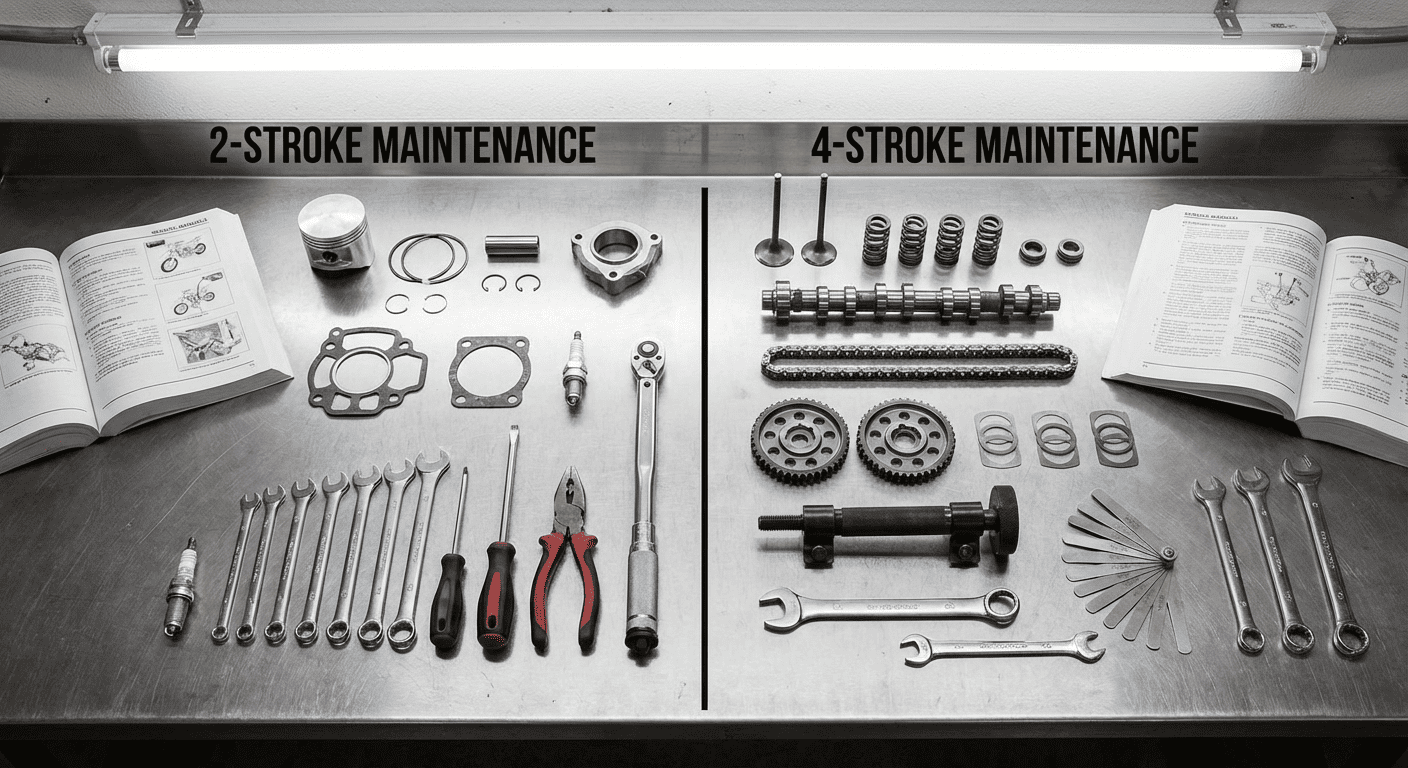
Because of the high-revving nature of the design, 2-strokes require more frequent service intervals because wear on parts such as piston rings and pistons occurs much faster. Rebuilding the top end is commonly done and usually isn’t that hard to do. For DIY bike maintainers, this is a pretty good bonus. In contrast, a 4-stroke can go quite a long time between major services before issues develop, making it very convenient for the majority of riders who like to spend their time riding and not in the garage. But a 4-stroke is much more complicated because of the number of parts involved when work needs to be done on the inside.
The cost difference in repairs is another significant consideration. Compared to 2-stroke, top-end rebuilding of 2-strokes is relatively inexpensive and is often a job one can do in a home garage. Replacement parts are usually fewer and tend to cost a bit less. On the other hand, repairs on a 4-stroke typically involve pricey components such as valves, timing chains, and camshafts. In addition, bottom-end work on a 4-stroke is much more involved and often requires special tools or labor; however, the trade-off is that such repairs don’t take place as often as a regular 2-stroke service.
Owning a dirt bike isn’t just about the ride; it has a lot to do with the total costs months or years down the line.
The initial outlay for 2-stroke bikes is usually less than that for 4-stroke bikes, and thus, 2-strokes are very tempting to beginners looking to get onto the track without spending an arm and a leg. Lower initial costs also make them a good choice for riders who want a second bike for variety. On the other hand, a 4-stroke model is usually more expensive, mainly on account of its complex design and components. The steep entry price has long been thought to be compensated for by the longer service intervals and resistance to breakdowns that 4-strokes bring, as some riders swear by it.
Fuel and oil requirements differ between the two. For a 2-stroke, either you have pre-mixed the fuel or the bike has an oil injection system. This adds a tedious step every time you refuel the bike. The other downside is that they consume a lot of fuel in comparison to 4-strokes, which are more fuel-efficient, a significant factor when you weigh it over a riding season. Changes are easy with 4-strokes, and not having to fuel-mix takes a lot of stress off daily tasks for the rider.
Environmental laws would determine your choice of bikes while riding in regulated areas. Lots of areas have stringent emission laws, which ban some 2-stroke models from public land, California being one of them. Thus, conventional 2-stroke engines are always directed to emit more unburnt fuel into the atmosphere; this triggers the banning of rides on a 2-stroke engine in some national forests or certain trail systems. Meanwhile, 4-strokes seem to have cleaner emissions, allowing for their operation in more places.
Pick the right bike for yourself based on how and where you usually ride most of the time.
If racing in short, intense courses with jumps, a 2-stroke excels with its twitchy response for whips, aggressive lines, instant throttle response, and light frame. The power is immediate for last-second corrections. 4-strokes are made for the sustained power of longer motos, where endurance really matters. You just go on your multiple laps without worrying about shifting: no stress, less fatigue, and you’re still able to contend.
In enduro riding and technical trails where agility and quick recovery from obstacles are essential, two-strokes hold an advantage. Their lighter weight makes it easier for riders to push, lift, or maneuver the bike over logs, rocks, and other obstacles.
For long distances and mixed terrain, however, four-strokes stand out. Their added stability, smoother power delivery, and superior fuel efficiency reduce the need for frequent refueling and provide a more consistent, less fatiguing ride over the course of a day.
It is also important to consider the torque advantage of four-stroke engines. In certain technical sections, the ability to deliver strong, controllable low-end power can make challenging climbs and slow, difficult terrain more manageable.
It will therefore be easy to pick up after falling, but the twitchy throttle response may be something difficult for a beginner to control. Power delivery is typically smoother on a 4-stroke, which allows a bit of extra time for the beginner to react, build confidence, and not be saturated with too much of a challenge. So, it’s the best dirt bike for beginners. It is recommended to start learning balance and control on a four-stroke first before proceeding and tackling a more aggressive power plant.
Apollino earned its name as a maker of bikes fitting for every riding need without compromising quality.
Apollino concerns itself with lightweight chassis designs and engines steeped in tuning for the sake of very realistic riding conditions. For performance, handling, and comfort, the end-user can choose between the two engine configurations- 2-stroke or 4-stroke models- well sorted.
Apollino turns the race-grade performance into mass access with prices that compete with well-made componentry. Its ergonomics are beginner-friendly yet cater to the advanced rider in pursuit of reliable handling and comfort.
Technology has dramatically contributed to the 2-stroke vs 4-stroke bikes debate. Most modern systems of direct injection for 2-strokes nowadays have managed to drastically minimize fuel wastage and emissions for some models, even qualifying for some of the stringent ecological criteria while making them comparatively less restrained overall. This consequently means the rider shares the buzz of a 2-stroke with far fewer headaches. A 4-stroke engine, when it comes to modern light materials and compact engine design, would surely be farthest from being restricted since it helps greatly in minimizing weight and closing the performance between the two. These lash around the arbitral lane of justifiably proclaiming one either in efficiency, emissions, or agility, and these days make it quite a challenge to pitch one over the other.
A 4-stroke generally will go a little longer between rebuilds than a 2-stroke, whereas with the right maintenance, a 2-stroke can last a number of years.
Generally not. The rapid delivery of power can be very daunting for a newcomer, while a 4-stroke provides an easier learning curve for control.
The larger quantity of moving parts and greater complexity of the systems make the repairs more time-consuming and costly, necessitating the use of a lot more special tools.
Yes, many classes remain competitive for 2-strokes, where the most skilled may actually match or even surpass the performance of their 4-stroke counterparts.
For most, it is not about picking a clear winner between 2 and 4 strokes but rather getting themselves a dirt bike that suits their riding styles, budget, and preferences on maintenance. Riders who are aggressive with short bursts of speed would appreciate the raw and swift power of the 2-stroke. Control and endurance types of riders will favour stability and easy handling of the 4-stroke. So with modern innovation tearing down traditional barriers, it is not just preference anymore. The only way to tell? Get Apollino whichever bike you like, test it on the track, and see which one leaves you with the biggest smile when you get back to the pits.
 Get in Touch